Beyond B-Rep: Rethinking CAD Through a Universal Geometric Language
Explore NeuroCAD's research into a universal geometric language combining executable geometry, parametric composition, engineering semantics, and parallel computation.
NeuroCAD Research Notes · 01
How NeuroCAD is exploring a new foundation for parametric geometry, composable engineering objects, and parallel computation.
For decades, computer-aided design has relied on a familiar workflow: create a sketch, apply features, modify geometry, and rebuild the affected parts of the model whenever something changes.
This approach has enabled extraordinary engineering achievements. Boundary Representation (B-Rep), parametric feature histories, and geometric modeling kernels remain essential technologies across mechanical engineering, aerospace, automotive design, and manufacturing.
But an important question remains:
What if the geometry itself were an executable program, rather than merely the result of a sequence of modeling operations?
At NeuroCAD, this question is driving our research into a Universal Geometric Language (UGL) — an experimental approach to describing, composing, evaluating, and modifying engineering geometry.
Our objective is to investigate whether engineering geometry can be expressed through a unified mathematical and computational framework. This article describes a research direction, bounded prototype observations, and open questions; it is not a claim that a universally complete UGL product is available today.
Geometry as an Executable Program
Traditional parametric CAD typically describes a component through features and their dependencies. A block may be extruded, drilled, filleted, and modified through a history of dependent operations.
UGL explores a program-centered abstraction.
A geometric object can be represented as a typed program containing its primitives, parameters, relationships, constraints, and composition rules.
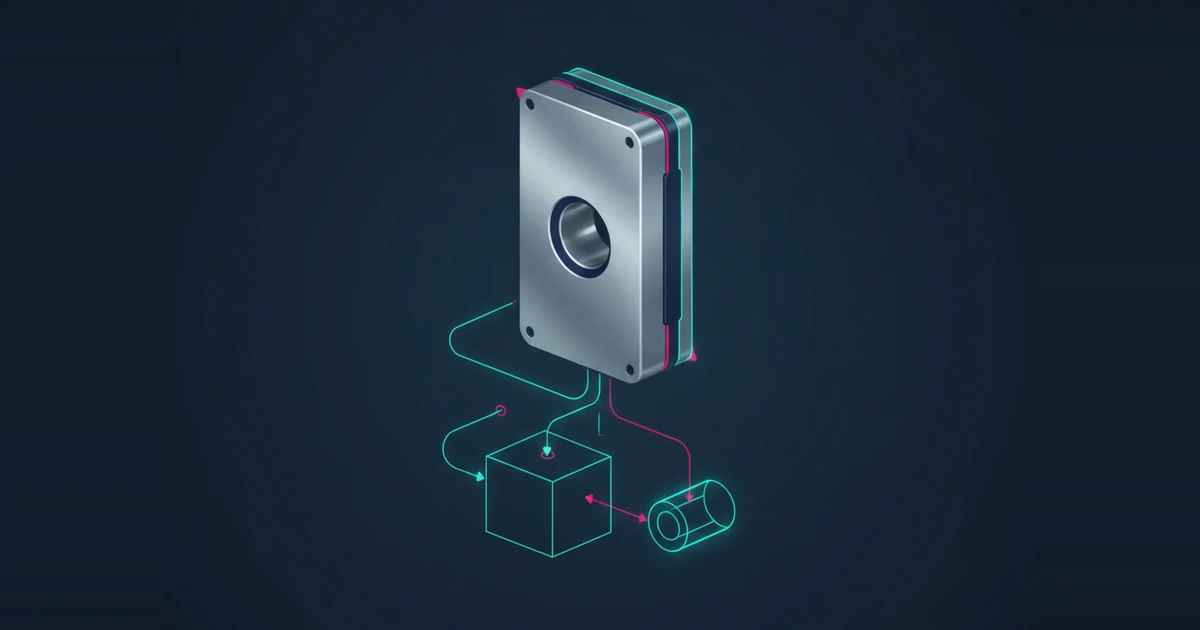
Consider a simple housing with a cylindrical opening:
Housing = Difference(Box, Cylinder)
Both operands retain their own definitions and parameters.
Programmable geometry is an established idea: systems such as OpenSCAD already describe solids through programs. Our research asks how a common language could coordinate multiple mathematical representations while retaining engineering relationships and explicit limits on conversion.
The resulting geometry could be evaluated through different representations, depending on the engineering task. Manufacturing exchange may require an exact B-Rep projection, while simulation may require an appropriate computational mesh or an unfitted discretization.
These are task-specific projections, not automatically interchangeable forms. An exact projection requires a supported, validated conversion; a common language does not make arbitrary conversion lossless.
The key architectural idea is to separate what the geometry means from how the geometry is evaluated.
From Simple Primitives to Composable Engineering Objects
One of the central ideas emerging from our research is that a primitive does not need to be simple.
A box, cylinder, curve, or surface can be a primitive. But so can a complete parameterized housing, mounting bracket, cooling channel, or mechanical subassembly.
Each object could expose a controlled interface containing:
- Geometric parameters and engineering dimensions.
- Reference frames, surfaces, axes, and connection points.
- Parametric constraints and dependencies.
- Supported geometric composition operations.
- Engineering interfaces and functional relationships.
These objects could then be combined recursively to construct more complex systems.
Instead of repeatedly recreating the same geometry, engineers could reuse geometric definitions and instantiate them throughout a design. Reuse does not remove the need to evaluate changed dependencies or validate a particular composition.
This introduces the possibility of a CAD environment built around composable engineering objects as well as modeling commands.
Magnetic Parametric Composition
Imagine creating two complex geometric objects independently.
The first is a fixed mechanical housing. The second is a mounting feature.
As the engineer drags the mounting feature toward the housing, the CAD system could recognize nearby surfaces, axes, geometric references, and compatible connection interfaces. It could then propose meaningful operations:
Align. Constrain. Join. Subtract. Intersect. Mate.
The engineer chooses the intended relationship, and the system creates the corresponding parametric composition.
Dimensions may remain independent or become linked to existing geometry. For example, the mounting feature could inherit the diameter of another hole, align with a reference axis, or extend to a selected surface.
This concept — which we call Magnetic Parametric Composition — could bring Boolean operations, geometric constraints, and positioning into a unified construction workflow.
The objective is to make sophisticated parametric relationships easier to establish and maintain while retaining engineering control. Automatic recognition, ambiguous matches, and the choice between several valid relationships remain research questions; this is a proposed interaction, not a claim of a completed drag-and-compose workflow.
Deformable Primitives and Adaptive Surfaces
The same principle can extend beyond rigid analytical solids.
Consider a box whose six faces are represented by controllable parametric surfaces. Its geometry could be modified through Bézier, B-Spline, NURBS, subdivision, or other surface-construction methods.
By changing control points, boundary conditions, and continuity constraints, engineers could generate increasingly complex forms while retaining explicit parameters.
Now imagine combining two such deformable objects. The system could propose a controlled geometric adaptation that satisfies specified connection conditions.
This opens a research direction in which surface continuity, local deformation, and parametric composition become part of the same mathematical framework.
Achieving this reliably requires robust treatment of topology changes, geometric continuity, numerical accuracy, and constraint solving. These remain active research challenges.
Connecting CAD Geometry to Systems Engineering
A particularly promising extension is the relationship between geometric composition and Model-Based Systems Engineering (MBSE).
Engineering components are more than shapes.
An electric motor, for example, may expose mechanical mounting interfaces, a rotating shaft, electrical connections, thermal interfaces, and control signals. A universal engineering object could represent these interfaces as typed semantic ports.
Connecting a motor to a gearbox could therefore establish both a geometric relationship and a functional relationship, provided the interfaces and constraints are compatible.
This suggests a potential connection between UGL and NeuroCAD Architect, where system-level functions, requirements, and interfaces could be associated with the geometry that realizes them.
The longer-term objective is a consistent engineering model connecting:
Requirements → Functions → Interfaces → Geometry → Simulation → Verification
Such a model could improve change-impact analysis and traceability across engineering disciplines. A typed connection alone does not establish physical compatibility or verify system behavior.
Parallel Evaluation of Geometric Programs
Parallel computation is another important research direction.
Many existing geometric kernels already support parallel operations. For example, the Open CASCADE Boolean-operation API exposes parallel execution controls. B-Rep itself does not require a sequential implementation.
UGL explores how an execution graph could be derived from the geometric program and its actual dependencies. Independent evaluations may execute concurrently, unchanged results may be reused, and expensive representations may be materialized when required.
This does not imply that every geometric operation can be parallelized.
Our bounded experiments have shown acceleration for suitable independent analytical geometry-query workloads, while dependency-heavy workloads may gain little or become slower. Speeding up queries over already available geometry is not evidence that constructing a complete CAD part becomes faster.
The research challenge is to determine which computations are necessary, which are independent, and which can be avoided altogether.
What Our Research Has Demonstrated
Across successive UGL research revisions, NeuroCAD has investigated analytical geometry, exact B-Rep operations, and graph-based evaluation. GPU execution is a separate implementation and qualification direction; CPU research results do not establish a GPU implementation of the same language.
Within explicitly restricted prototype grammars and test cases, our research records include:
- Executable geometric programs for defined classes of geometry.
- Recursive geometric definitions and reusable instances.
- Bounded composition and geometric relationship evaluations.
- Incremental evaluations compared with independent full recomputation in selected cases.
- Independently reproduced parallel acceleration for suitable analytical geometry-query workloads, alongside retained slowdowns on other workloads.
- Typed engineering interfaces and dimensional consistency checks within defined prototype domains.
These are experimental observations under stated assumptions, not production-kernel qualification or a universally complete geometry language. Prototype definitions and semantic records do not by themselves establish a durable, integrated engineering model.
Generalized topology preservation, arbitrary geometric conversions, advanced surface composition, and industrial-scale engineering qualification remain open challenges. Some broader hypotheses have been refuted by counterexamples; those failures are part of the research record.
We believe that distinguishing demonstrated capabilities from unresolved questions is essential to building a credible engineering platform.
Toward an Optimal Engineering Geometry Basis
Our current research is moving toward a deeper question:
What mathematical primitives, operators, and relationships are sufficient to describe the geometry required across engineering disciplines?
Rather than pursuing the smallest possible collection of primitives, we are investigating an optimal engineering basis.
Candidate mathematical families include analytical curves and surfaces, freeform splines, solid regions, implicit geometry, discrete geometry, deformable structures, constructive operators, topological relationships, and parametric constraints.
The objective is to evaluate these capabilities across mechanical engineering, aerospace, automotive design, electronics, manufacturing, robotics, thermal systems, and other engineering domains.
A successful framework must preserve the precision, parameterization, editing behavior, and engineering relationships required by the intended application. No globally optimal or universally complete basis has been established by this research.
The Road Ahead
Our research strategy follows a simple principle:
Prove the mathematics. Validate the algorithms. Then invest in implementation.
We are using formal reasoning, lightweight executable prototypes, independent reproduction, and adversarial testing to examine the proposed architecture before committing to large-scale kernel development. A restricted argument or passing prototype does not prove a universal claim.
The next stage is to investigate the mathematical completeness, practical coverage, and computational efficiency of the proposed geometric basis.
We are exploring whether a common language can coordinate multiple mathematical approaches while preserving the engineering meaning of the underlying design. Different tasks can continue to require different representations.
A Different Foundation for Engineering Design
The future of CAD may be shaped by a more expressive way to describe engineering intent.
At NeuroCAD, we envision a system in which geometry is programmable, primitives are composable, parameters remain connected, engineering interfaces carry meaning, and computation adapts to the task.
Geometry as an executable engineering language.
That is the direction we are exploring with UGL.
NeuroCAD Research & Development | Universal Geometric Language
Discuss NeuroCAD as a pilot or investment opportunity.
Working MVP/demo is available for qualified conversations.
Contact the Founder