AI-native CAD
with a dual-engine kernel.
NeuroCAD combines an SDF geometry engine with a Geometric Algebra engine, synchronized through five graph layers for browser-native mechanical design.
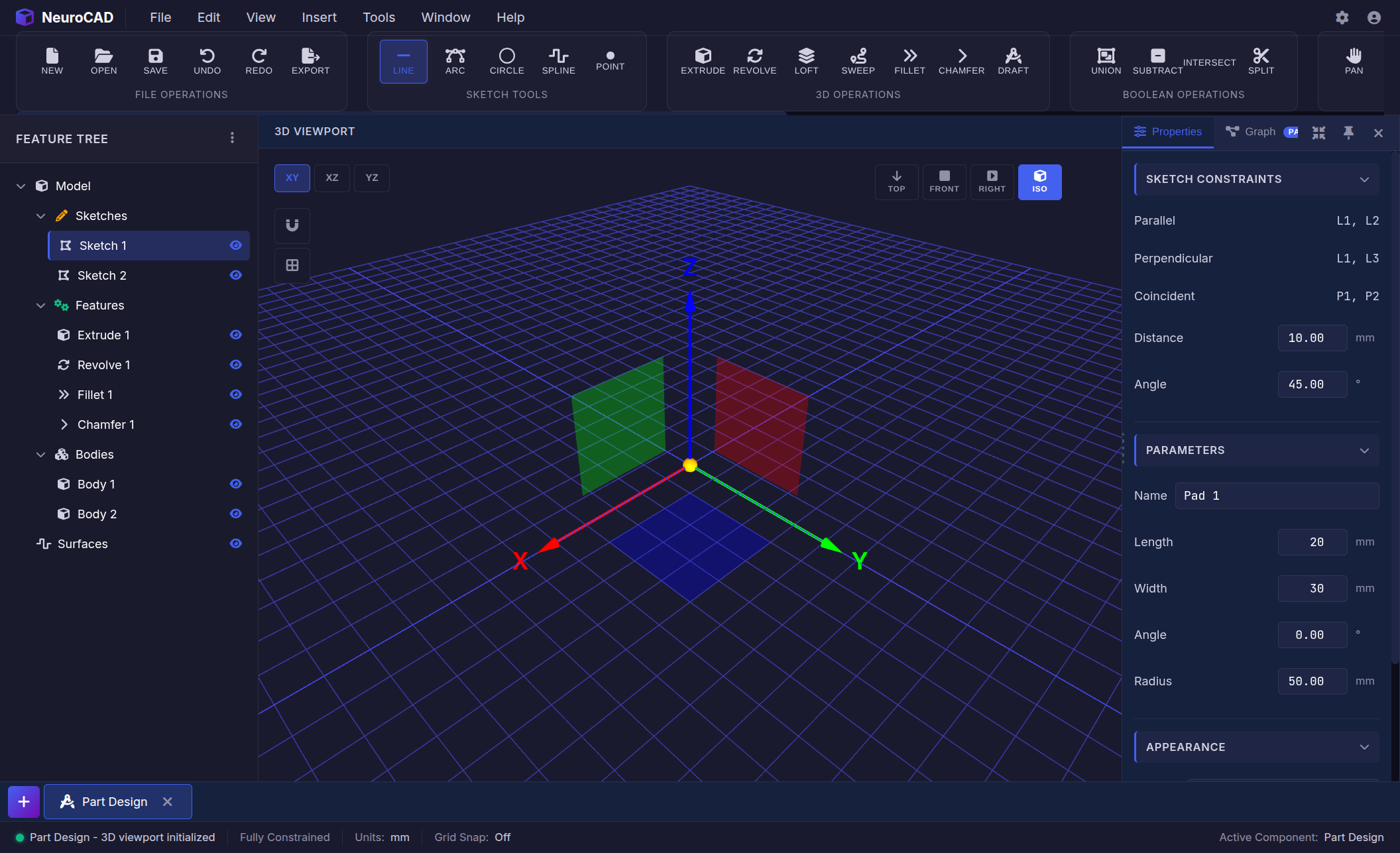
Built as a platform.
Not a plugin.
From parametric sketching to simulation-ready geometry. One product surface over two mathematical engines and a coherent graph stack.
Sketch & Constraint Authoring
Deterministic constraint solver with canonical outcomes. Lines, arcs, circles, splines with geometric and dimensional constraints.
Feature Kernel
Implemented kernel paths for sketch-to-extrude and sketch-to-revolve, plus feature history and edit-intent infrastructure. Fillet/chamfer and richer feature workflows are being hardened for pilots.
Surface Modeling
Surface layer with NURBS admission/evaluation, loft/sweep execution contracts, surface session workflows, and quality/healing diagnostics. UI-level workflows are being productized.
Organic & Field Modeling
Field-native geometry with PDE-driven shape evolution. Sculpt, deform, and evolve surfaces with exact-zone protection.
Feature-Preserving Booleans
SDF booleans and smooth variants are implemented in kernel/session paths. Feature-preserving boolean reports and evidence exist, with integration hardening ongoing.
Diffusion & Evolution
Reaction-diffusion systems, mean curvature flow, Laplace-Beltrami operators. Bounded field evolution with replay safety.
Differentiable CAD
Gradient exposure for lawful geometry optimization. Sensitivities flow through the entire design graph.
Lattice Engineering
Graded lattice generation with parametric unit cells. Gyroid, diamond, octet — tuned for strength, weight, or thermal conductivity.
Material Fields
Continuous material grading from one zone to another. Per-voxel multi-material assignment for PolyJet and MJF printing.
Multi-Scale Composition
Macro structure + micro lattice + material grading, coordinated as a single design. Scales from millimeters to meters.
Manufacturing Governance
Manufacturing constraints are moving into governed design workflows. Wall thickness, draft, overhang, export, and validation evidence are tracked through deterministic gates.
Metrology & Inspection
Measurement, tolerancing, GD&T, QIF/DMIS, and inspection evidence loops for validation-driven engineering workflows.
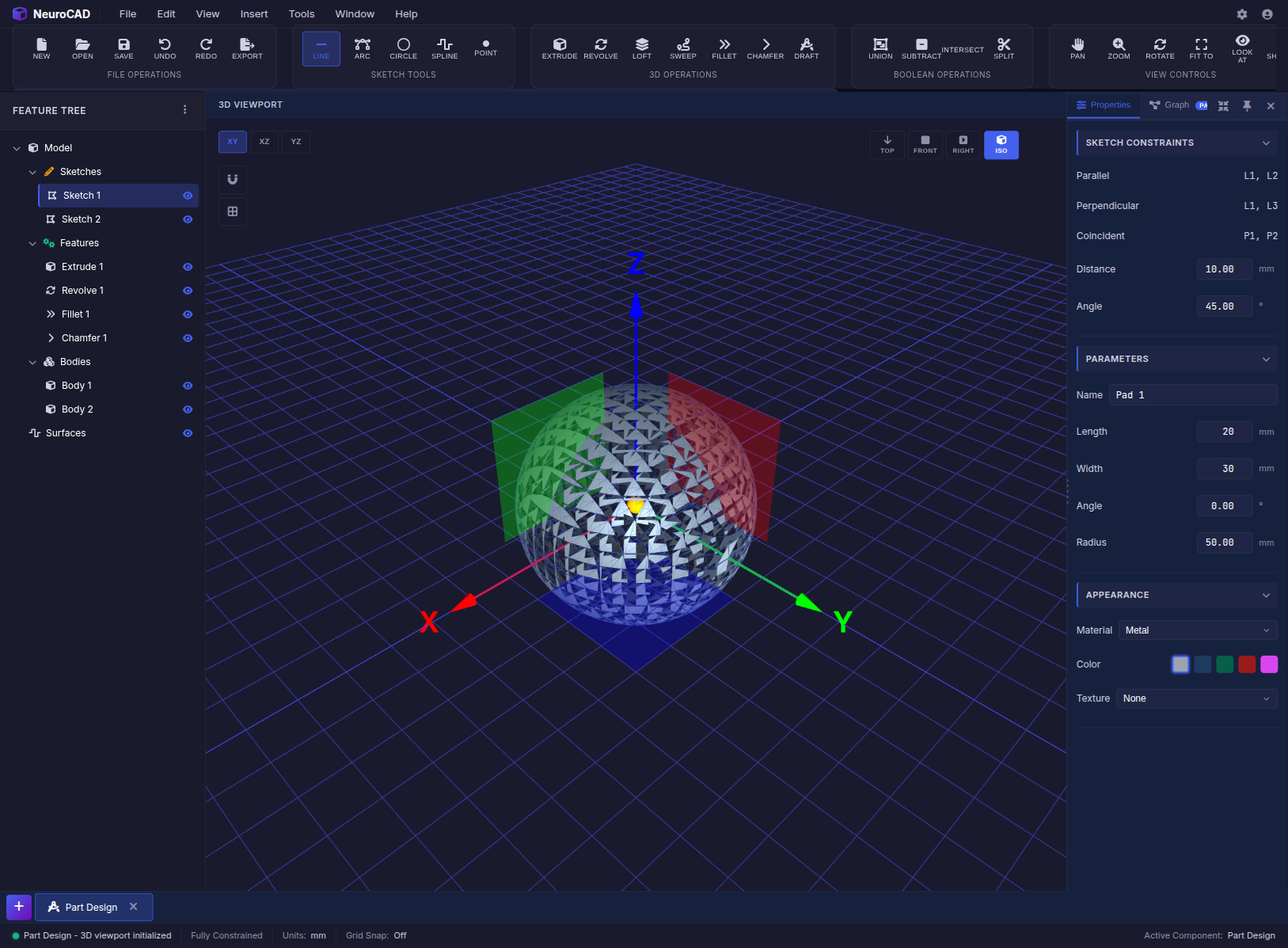
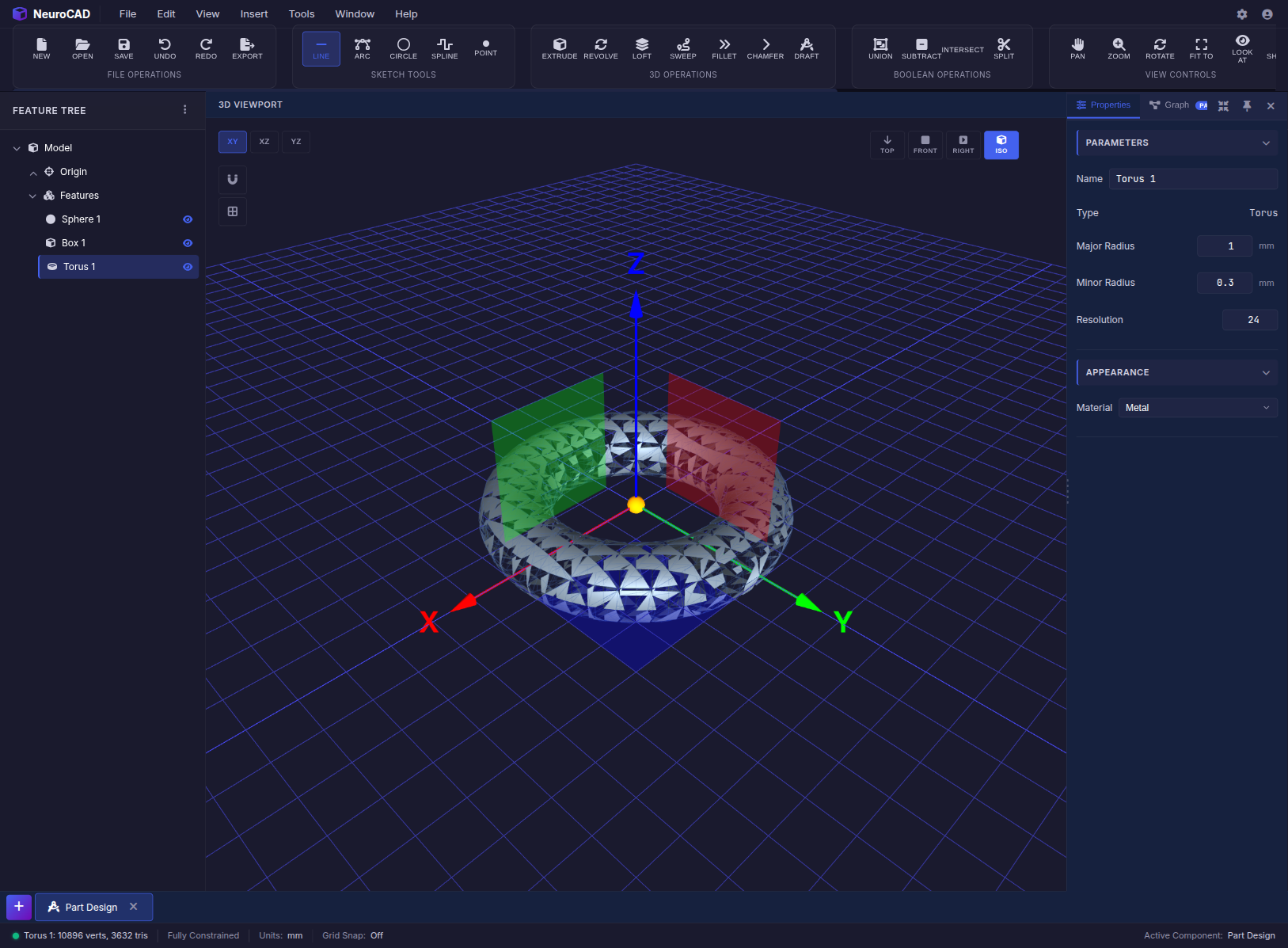
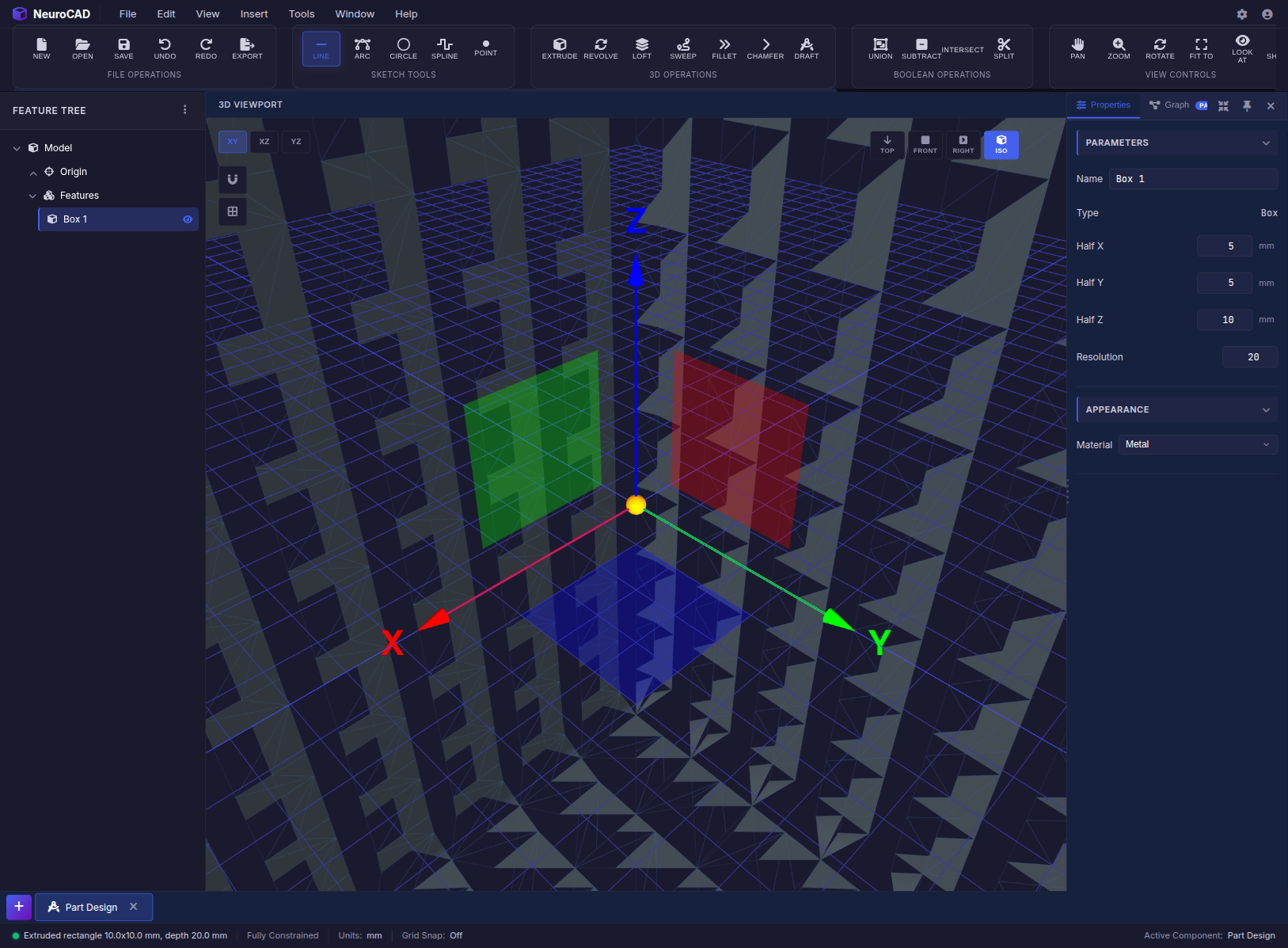
Two mathematical engines.
One coherent CAD state.
DUAL MATHEMATICAL KERNEL
- Engine A: Signed Distance Fields and nalgebra/f64 evaluation for numeric geometry
- Engine B: Geometric Algebra in CGA + PGA for structure, transforms, and motors
- Dual-engine coherence checks compare Engine B projections against Engine A values
- E-graphs provide equality saturation and canonical-form extraction
- DCG, BVH, and NeuroGraph keep updates coherent across committed states
EXECUTION
- WASM compilation — kernel runs in the browser
- WebGPU — GPU-accelerated field evaluation and rendering
- Web Workers — kernel in background, UI always responsive
- Deterministic replay — every design reproducible from graph
- CRDT collaboration — real-time multi-user editing
MATHEMATICS
- PDE operators — reaction-diffusion, curvature flow, Laplace-Beltrami
- Adaptive field resolution — multi-scale refinement
- Differentiable geometry — gradients for optimization
- Variational reconstruction — surface fitting from point clouds
INTEGRATION
- MOOSE bridge — finite element simulation coupling
- Multi-format export — STL, STEP with semantic overlays
- AI orchestration boundary — proposals validated, never source of truth
Not only SDF. NeuroCAD has two complementary mathematical engines.
The REV11.2 specification defines Engine A as SDF/nalgebra numeric evaluation and Engine B as Geometric Algebra in CGA and PGA. The five graph layers keep these engines synchronized in a committed CAD state.
SDF numeric geometry
Signed Distance Fields and nalgebra/f64 evaluation provide the numeric geometry truth: inside/outside, distance, gradients, booleans, offsets, and field composition.
Geometric Algebra CGA + PGA
CGA represents spheres, planes, circles, and tangent constructions. PGA represents rigid motion, screw axes, motors, mates, and mechanism paths.
Projection and audit gates
Overlap operations are reconciled through projection π and per-operation tolerance ε. Engine disagreement is treated as a correctness signal, not hidden tolerance magic.
NeuroFEM / NEMO.
One model. The physics lives in the data.
NEMO is a geometry-native, physics-conditioned neural surrogate for multi-physics simulation. One trunk selects its operator from a discrete physics-mode id plus material and boundary conditions — with the classical solver (MOOSE) as final judge and a refusal, never a fabricated field, when it cannot answer.
15 physics modes, 42 proven generators
One trunk, one discrete mode id. 42 MOOSE generators proven on real solves; 52 coupling configurations classified and solved by an in-core fixed-point loop with a measured stability criterion.
174 formulas, three independent methods
Every formula-bearing claim extracted from the code and checked symbolically (Wolfram), by derivation (sympy) and numerically (pytest). 31 verified three ways, 9 declared GAP. The failures are published too.
20 differentiable physics
The gradient flows through the CutFEM solvers — 125/125 live tests. Peak stress driven from 209.5 to 180.8 MPa (-13.7%), monotonically, and the geometry comes back editable.
Not another CAD.
A different foundation.
| Capability | NeuroCAD | SolidWorks | Fusion 360 | nTop | Onshape |
|---|---|---|---|---|---|
| Implicit Geometry (SDF) | ✓ | — | — | ✓ | — |
| Parametric Sketching | ✓ | ✓ | ✓ | — | ✓ |
| Surface Modeling | ✓ | ✓ | ✓ | — | ✓ |
| Lattice Engineering | ✓ | — | — | ✓ | — |
| Differentiable CAD | ✓ | — | — | — | — |
| Browser-Native | ✓ | — | ~ | — | ✓ |
| WebGPU | ✓ | — | — | — | — |
| Deterministic Replay | ✓ | — | — | — | — |
| Material Fields | ✓ | — | — | ✓ | — |
| Manufacturing Governance | ✓ | ~ | ~ | — | — |
| AI Orchestration | ✓ | — | ~ | — | — |
| Simulation Bridge | ✓ | ~ | ✓ | — | — |
From aerospace to medical.
One platform.
Additive Manufacturing
- →Per-voxel multi-material assignment
- →Lattice grading for weight optimization
- →Conformal cooling channel design
- →4D printing of stimulus-responsive structures
- →Functional surface texturing
Aerospace
- →Structural topology optimization
- →Multi-scale composite design
- →Acoustic metamaterial panels
- →Thermal management geometry
- →Lightweight lattice wings
Medical Devices
- →Bio-inspired trabecular bone structures
- →Conformal fit from CT/MRI scans
- →Functional biocompatible surfaces
- →Multi-material gradient implants
- →Scan-to-CAD reconstruction
Automotive
- →NVH optimization with acoustic metamaterials
- →Conformal cooling for injection molding
- →Lightweight suspension components
- →Topology-optimized brackets
- →Manufacturing-aware geometry
Consumer Products
- →Organic form generation
- →Programmable mechanical properties
- →Topology optimization workflow setup
- →Procedural texturing for 3D printing
- →Multi-material soft/rigid zones
Energy & Sustainability
- →Heat exchanger optimization
- →Lattice structures for conductivity
- →Solar panel self-cleaning surfaces
- →Wind turbine blade internal lattice
- →Thermal energy harvesting devices
Built in phases.
Validated with pilots.
R1 is the foundation layer. The investor story is the broader platform: pilot geometry, design intelligence, and industrial validation are already represented as tested kernel workflows under product hardening.
Core Geometry MVP
MVP LIVE- Sketching and constraints
- SDF primitives and booleans
- Interactive field preview and meshing
- STL export path
- Deterministic replay
Feature & Surface Kernel
PILOT FOCUS- Sketch extrude/revolve are live SDF features
- NURBS, loft, and sweep kernel paths are implemented
- Healing diagnostics and validation gates are in place
- Smooth SDF booleans are live, with feature-preserving evidence layers
- Surface-field conversion is moving through pilot hardening
AI-Assisted Design & Optimization Workflows
TESTED FLOWS- Organic field modeling with protected exact-zone gates
- Gated diffusion / neural design operations
- Differentiable CAD signals for gradients, curvature, and SDF deltas
- Material fields with deterministic geometry coupling
- Multi-scale geometry composition across smooth SDF, morph/warp, and lattice fields
Manufacturing & Validation
EVIDENCE GATES- Lattice engineering workflows with certification gates
- Metrology, GD&T, QIF/DMIS, and inspection evidence loops
- Manufacturing governance, BOM/PDM, and export readiness gates
- Topology optimization workflow scaffold under hardening
- TPMS, strut, Voronoi, plate, and neural lattice pattern libraries
Design partner access, not public SaaS pricing.
NeuroCAD is moving from MVP/demo toward focused pilot and design partner validation.
Demo Review
Short technical and business review for investors, advisors, and potential design partners.
- ✓Working MVP/demo overview
- ✓Architecture walkthrough
- ✓Current status split
- ✓Pilot fit discussion
- ✓Follow-up materials
Design Partner
Structured collaboration around one high-value workflow, with clear success criteria and evidence capture.
- ✓Workflow scoping
- ✓Pilot milestone plan
- ✓Geometry and export validation
- ✓Commercial feedback loop
- ✓Priority founder access
Enterprise / Strategic
For industrial teams, strategic partners, and investors evaluating deeper technical collaboration.
- ✓Technical due-diligence session
- ✓Roadmap alignment
- ✓Security/IP discussion
- ✓Pilot or investment process
- ✓Legal review when needed
Discuss NeuroCAD as a pilot or investment opportunity.
Working MVP/demo available for qualified investor and design-partner conversations.