Aerospace Geometry: Keeping Datums, Variants, and Evidence Connected
An equipment-support bracket illustrates aerospace geometry concerns around datums, configuration changes, manufacturing context, and evidence.
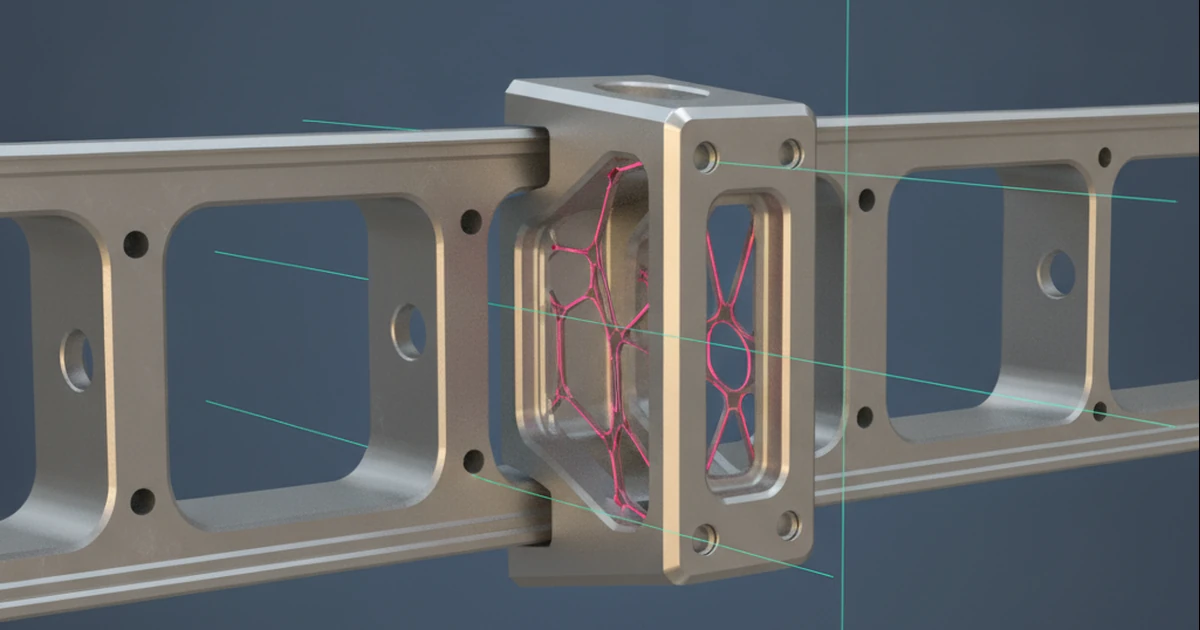
An aircraft equipment bracket is a small component with a large context.
Its mounting faces relate to an airframe installation. Its envelope interacts with adjacent equipment. Its material and manufacturing route influence which geometric details matter. Its verification evidence belongs to a specific configuration.
This note uses a hypothetical bracket to examine what programmable geometry could contribute. It makes no aerospace certification or deployment claim for NeuroCAD.
Keep datums separate from incidental faces
Suppose the bracket is reshaped to reduce mass while its mounting relationship must remain fixed.
A reference to a convenient face may become fragile if that face is split or removed. A design definition could instead expose an intentional mounting frame whose meaning is maintained or explicitly invalidated during the edit.
That would not solve every reference-stability problem. It would make the desired behavior clearer than relying on whatever face identifier survives.
Treat variants as controlled decisions
An equipment family may use several mounting patterns. Shared geometric definitions could describe common features while explicit variant parameters describe the differences.
The engineering question is which changes are permitted within that family. A parameter combination that has never been evaluated should not inherit another variant’s approval simply because both came from the same definition.
Reusable geometry and reusable qualification are different propositions.
Preserve manufacturing and inspection intent
A shape suitable for exploration may omit information needed for production or inspection. An engineering workflow may need tolerances, process constraints, accessible measurement references, and a controlled exchange representation.
A freeform or implicit construction does not remove those obligations. If a downstream artifact approximates a boundary, the approximation needs to be assessed for its intended purpose.
The proposed common definition would be useful only if those obligations remain visible.
Connect changes to the relevant evidence
Moving a mounting hole could affect structural analysis, fit checks, and installation documentation. A connected model might help identify those dependencies and request appropriate review.
It should not announce compliance merely because the geometry regenerates. Verification still requires the methods and authority appropriate to the component and program.
The research opportunity is clearer management of engineering intent through geometry changes. Demonstrating that opportunity would require a bounded workflow with traceable variants and independently reviewed outputs—not a recognizable aircraft part in a viewport.
Research note: These proposed workflows do not establish current NeuroCAD feature availability, performance, or engineering qualification.
Discuss NeuroCAD as a pilot or investment opportunity.
Working MVP/demo is available for qualified conversations.
Contact the Founder