From CAD to MBSE: Connecting Geometry with Engineering Intent
A pump assembly shows how requirements and functions could guide geometry without confusing a systems model with a validated physical design.
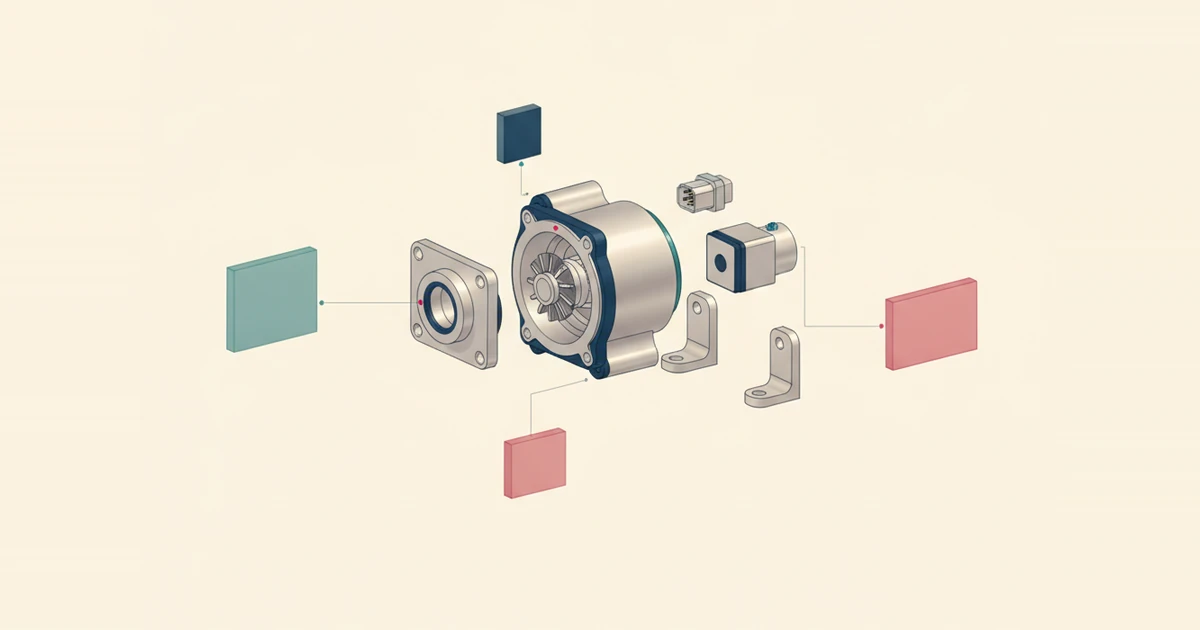
A pump housing can satisfy its dimensional drawing and still fail to realize the intended system.
Its ports may be in inconvenient positions. The assembly may be difficult to service. A mounting arrangement may conflict with another subsystem. These are not all questions that a solid model can answer by itself.
The potential connection between Universal Geometric Language (UGL) and NeuroCAD Architect concerns this gap between a geometric component and the system role it is meant to fulfill.
Trace a function to a physical realization
Imagine a system function called “circulate coolant.” That function could be allocated to a pump assembly with inlet, outlet, power, and mounting interfaces.
Geometry would realize some of those decisions: passage locations, connection faces, clearances, and mounting references. It would not by itself prove the required flow, reliability, or serviceability.
A useful association would therefore identify which requirements concern which geometric features and which additional evidence is needed.
Preserve relationships without claiming equivalence
A system interface might specify a connection direction and an operating envelope. A geometric interface might describe a local frame and a physical opening.
Those descriptions can be linked, but they are not interchangeable. Matching an opening diameter would not establish acceptable hydraulic performance. Matching a mounting pattern would not establish structural adequacy.
The link should support engineering questions, including questions whose answer remains unknown.
Make a change request concrete
Suppose the outlet moves to avoid an obstruction. The change may affect routing, maintenance access, packaging, and pressure-loss analysis.
A connected model could identify the linked items for review. It should not assume that every associated result is invalid, nor that every unaffected-looking result remains valid. The decision depends on the assumptions recorded by each discipline.
This is where explicit allocation and evidence references could make a systems model more useful than a collection of disconnected diagrams.
Keep verification and validation visible
A trace from a requirement to a component is a navigation aid, not a pass result. The NASA systems engineering guidance distinguishes demonstrating requirement compliance from establishing suitability for intended use.
For the pump example, a proposed experiment would ask whether engineers can follow a requirement to its physical realization, identify the responsible analysis, and recognize stale evidence after a change.
That would test traceability in a bounded workflow. It would not establish complete MBSE integration or certify the pump. NeuroCAD is exploring this connection as a research direction.
Research note: These proposed workflows do not establish current NeuroCAD feature availability, performance, or engineering qualification.
Discuss NeuroCAD as a pilot or investment opportunity.
Working MVP/demo is available for qualified conversations.
Contact the Founder