SDF, FRep, NURBS and B-Rep: Different Mathematics, Different Strengths
A cooling channel illustrates the different responsibilities of implicit fields, functional definitions, NURBS surfaces, and B-Rep topology.
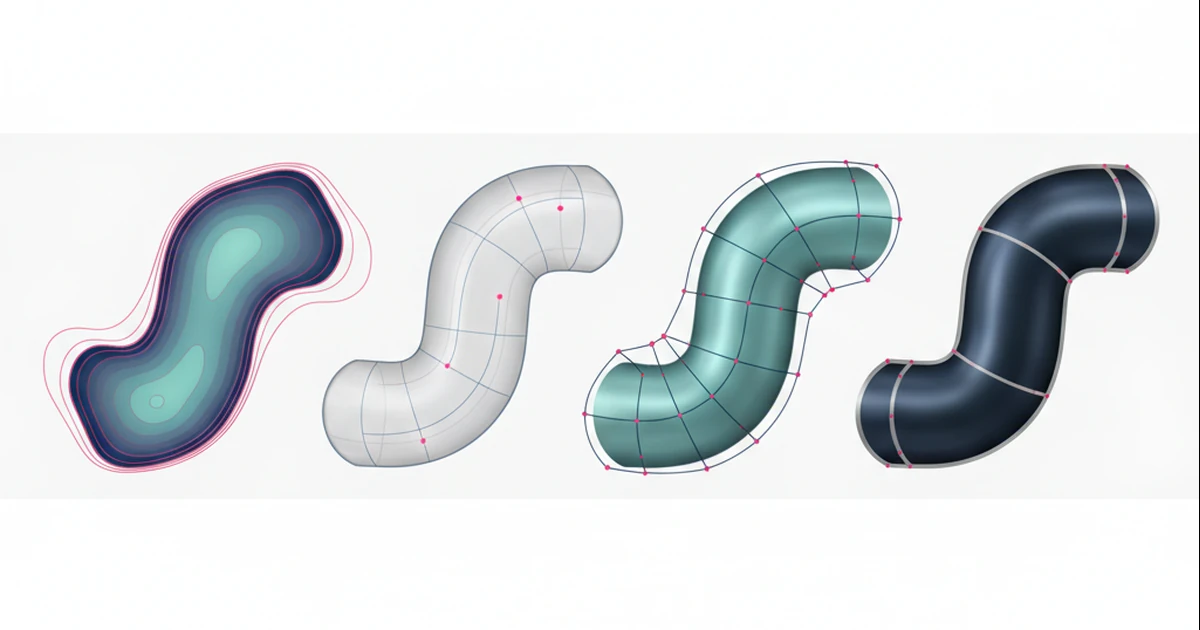
A cooling channel can appear as a region in a field, a collection of surfaces, a boundary-defined solid, or a discretized analysis domain.
These descriptions can serve the same design while answering different questions. Treating them as interchangeable would hide the conditions under which each is useful.
The Universal Geometric Language (UGL) research question is whether a common definition could coordinate such representations without pretending their guarantees are identical.
A field describes behavior over space
An implicit definition can classify locations relative to a region. A signed distance field adds a distance interpretation, subject to the validity of the particular construction and evaluation.
That distinction matters: a function with an inside/outside sign is not automatically an exact distance field. A visual boundary alone cannot establish distance accuracy.
For the channel example, an implicit evaluator might support spatial queries while leaving other tasks to another representation.
Function representation (FRep) describes a region using a continuous real-valued defining function. The sign convention determines membership, but the function need not measure distance. The HyperFun introduction describes this established approach. A signed distance field imposes an additional distance interpretation; the terms are related rather than interchangeable.
A surface description needs a solid context
NURBS can describe controlled freeform surfaces. A surface patch by itself does not determine all the relationships needed for an engineering solid.
An enclosure assembled from patches still needs a coherent interpretation of boundaries, joins, orientation, and interior. Editing one patch may require checking its relationships with neighboring patches.
Thus “supports NURBS” is not equivalent to “supports every freeform solid modeling operation.”
B-Rep makes boundaries and topology explicit
These choices can work together: a B-Rep face can use a NURBS or analytical surface as its geometry, while the B-Rep also records boundary topology and orientation.
A boundary representation can describe how faces, edges, and vertices relate. Those relationships are valuable for operations that depend on identified boundaries.
They also create obligations during editing and conversion. A modified boundary must continue to satisfy the validity requirements of the intended use.
No representation choice removes the need to check narrow passages, ambiguous intersections, or invalid input.
A common language must declare conversion limits
Suppose an engineer requests both a channel visualization and a manufacturing exchange artifact. The outputs should identify which design revision they describe and the assumptions used to produce them.
Sampling, approximation, reconstruction, and topology changes can affect what is preserved. A conversion should state its scope rather than carry a universal “lossless” promise.
NeuroCAD’s architecture policy reserves meshes for downstream exchange or analysis tasks; the interactive viewport is required to evaluate the SDF geometry directly.
The useful outcome would be a coordinated set of representations with explicit responsibilities. It would not be a claim that SDF, FRep, NURBS, and B-Rep are competing names for the same mathematical object.
Research note: These proposed workflows do not establish current NeuroCAD feature availability, performance, or engineering qualification.
Discuss NeuroCAD as a pilot or investment opportunity.
Working MVP/demo is available for qualified conversations.
Contact the Founder