Semantic Engineering Ports: Describing Interface Compatibility
Motor-to-gearbox connections illustrate how typed engineering ports could distinguish compatible descriptions from physically validated interfaces.
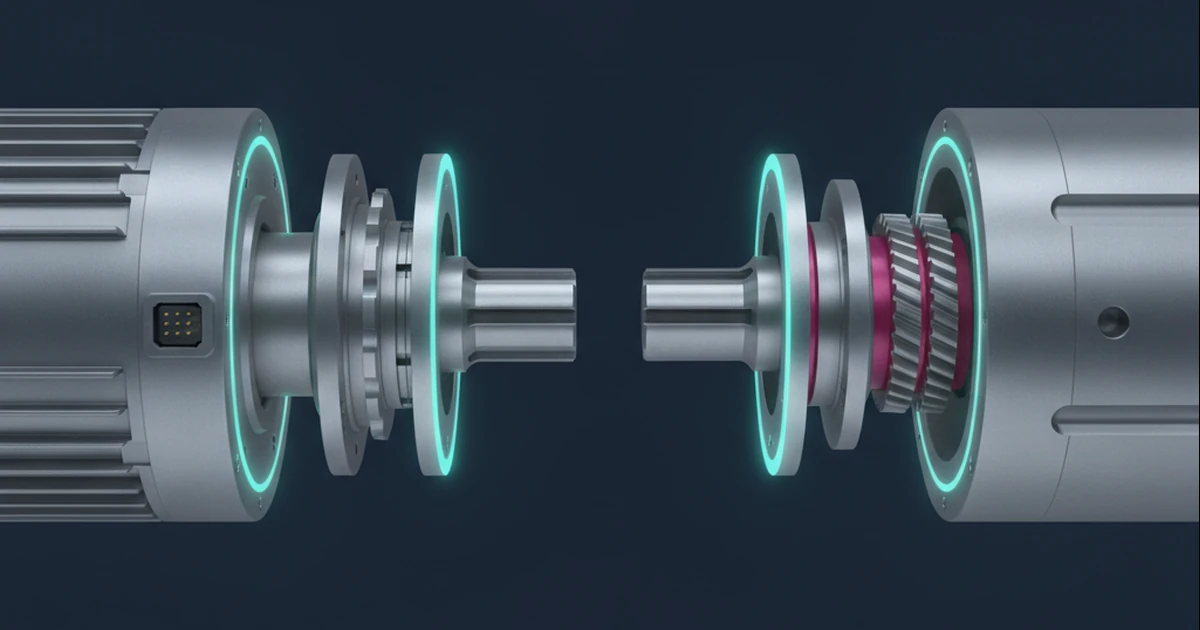
Two components can fit geometrically without forming a suitable engineering connection.
Consider a motor shaft and a gearbox input. Their axes may align, yet the coupling arrangement could be inappropriate for the required torque or permitted motion. A drawing of the connection does not answer every compatibility question.
Semantic engineering ports are a proposed way to make those questions explicit.
Describe what the connection means
A mechanical port could identify a local coordinate frame, an axis, a mounting reference, and the kind of motion it permits. Its engineering description could also refer to allowable operating conditions and the evidence supporting them.
An electrical port would need a different description. Shape and proximity would not determine voltage compatibility, signal meaning, or permitted current.
The common idea is a typed interface with domain-specific information, rather than a universal connector whose geometry is expected to explain everything.
Separate declared values from supported claims
Suppose a component definition contains a torque limit. That value should identify whether it comes from a supplier specification, an analysis, an experiment, or an unverified design assumption.
A matching procedure could compare declared values. It could not turn an unsupported assumption into a verified capability.
This distinction would help prevent a polished interface diagram from implying more confidence than its inputs justify.
Check compatibility in layers
For the motor and gearbox, an initial check might establish that the port categories can be connected. A placement check could then assess frame alignment. Further engineering checks would consider the coupling, loading, operating conditions, and relevant tolerances.
A pass at one layer should not erase a failure or unknown result at another. Dimensional consistency, for example, is useful without proving that the numerical values are appropriate.
Some compatibility decisions would remain with the engineer or the responsible domain analysis.
Explain the result to the user
An interface check should return a useful reason: incompatible motion, missing operating data, unresolved placement, or an assumption that needs confirmation.
“Connected” is too broad if it conceals those distinctions. Likewise, rejecting every incomplete description without identifying the missing information would make the system difficult to use.
A bounded experiment could test a small vocabulary of ports against known compatible, incompatible, and incomplete examples. The result would establish behavior for that vocabulary, not a general understanding of engineering intent.
NeuroCAD’s research question is whether such interfaces can improve composition and change review while leaving physical authority with the appropriate engineering evidence.
Research note: These proposed workflows do not establish current NeuroCAD feature availability, performance, or engineering qualification.
Discuss NeuroCAD as a pilot or investment opportunity.
Working MVP/demo is available for qualified conversations.
Contact the Founder