What an Engineering Geometry Basis Needs to Preserve
An engineering geometry basis must preserve topology, dimensions, and useful edits. A rounded enclosure exposes why recognizable shapes are insufficient.
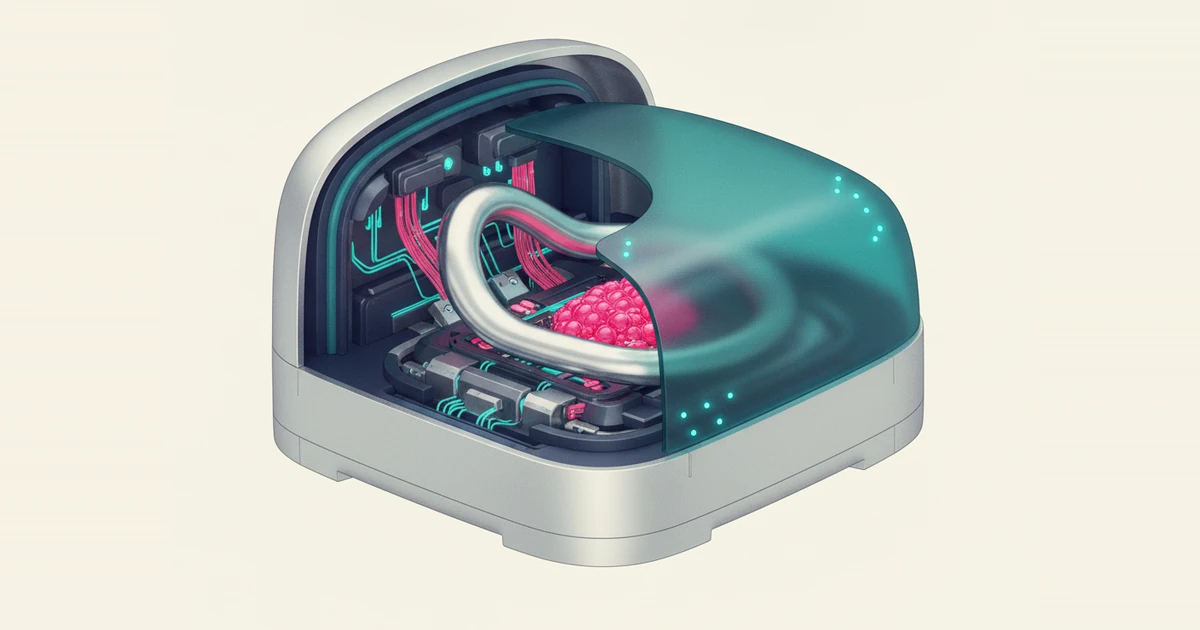
How many primitive types does a geometry language need?
Counting boxes, cylinders, and surface families is an appealing starting point. It is also an incomplete measure of engineering coverage. A language might approximate an enclosure’s appearance while losing the wall thickness, corner behavior, or editing relationships that make it useful.
For NeuroCAD’s research, a more productive question is: which constructions preserve the properties required by a specific engineering task?
Begin with an enclosure, not a catalog
Consider an enclosure with planar mounting pads, rounded corners, a freeform outer cover, and a passage through its interior.
The pads need stable placement references. The cover needs controllable shape. The passage must remain connected to the intended openings. The enclosure must describe a solid region rather than an unrelated collection of visible patches.
This example asks for several kinds of meaning at once. Merely reproducing its silhouette would provide little evidence of a suitable basis.
Surfaces do not settle solid validity
A collection of surface patches needs relationships describing how boundaries meet and which side belongs to the interior.
That distinction matters when a corner is reshaped. An edit that appears visually small could open a gap, reverse a region, or create self-intersection. The language needs a way to express the intended construction and report when the evaluator cannot maintain it.
For a concrete example of representation-specific validation, the Open CASCADE validity analyzer checks B-Rep conditions including orientation. Passing a check for one representation does not prove equivalent behavior in every other representation.
Include the edits in the coverage question
A proposed basis should be evaluated against operations engineers actually need.
Can the mounting pads remain planar while the cover changes? Can a wall-thickness parameter retain its intended interpretation? Can the passage move without disconnecting from its port?
Different answers may be acceptable for different application domains. What matters is making the boundary explicit.
Evaluate alternatives as a coverage matrix
Instead of declaring a universal winner, an experiment could compare candidate representations against construction, editing, validity, exchange, and analysis requirements.
The result might identify a strong basis for a bounded enclosure family while leaving another family unsupported. That would be useful progress without establishing mathematical completeness.
Our objective is an engineering basis whose guarantees can be explained and tested. A short primitive list is attractive only when it preserves the work engineers need to perform.
Research note: These proposed workflows do not establish current NeuroCAD feature availability, performance, or engineering qualification.
Discuss NeuroCAD as a pilot or investment opportunity.
Working MVP/demo is available for qualified conversations.
Contact the Founder